
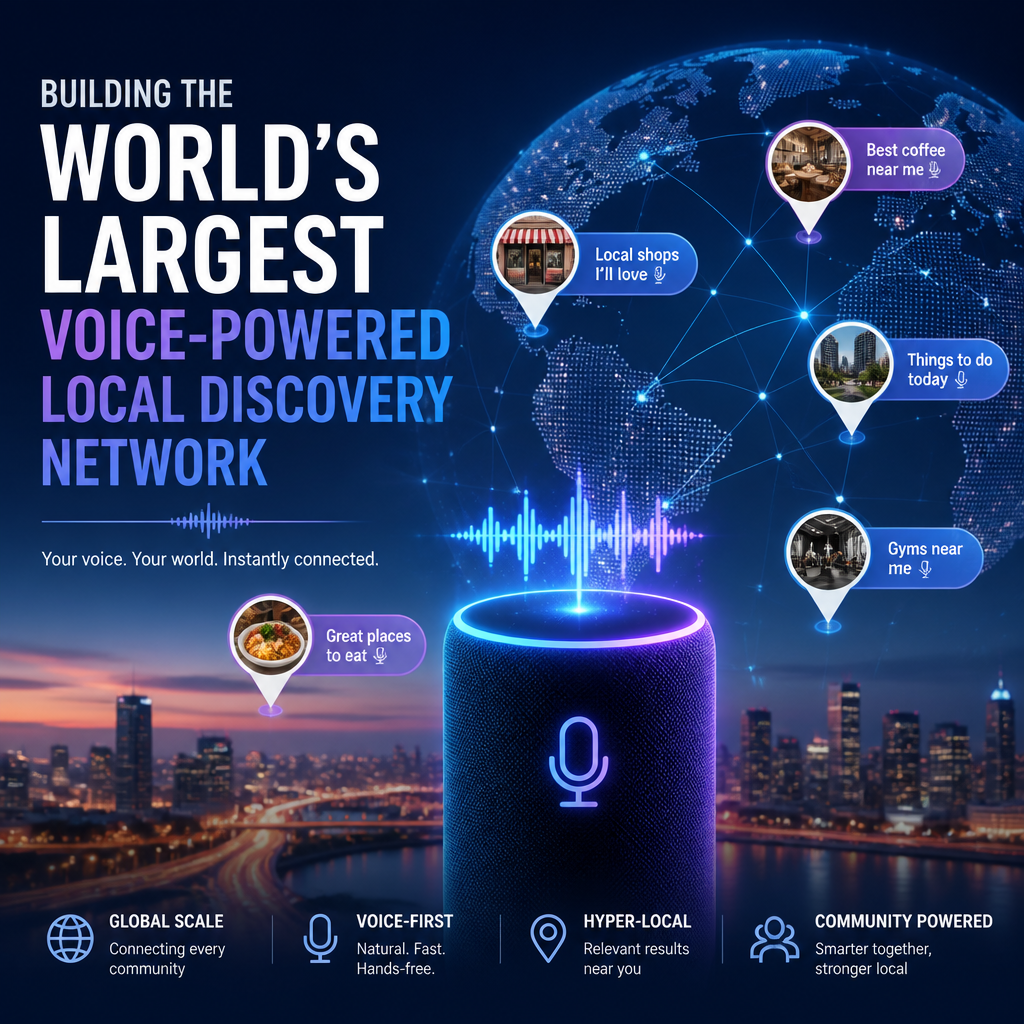
Building the World’s Largest Voice-Powered Local Discovery Network
Building the World’s Largest Voice-Powered Local Discovery Network
Local discovery is changing. Instead of typing queries into a search engine, people are increasingly asking voice assistants where to eat, what to do, and which nearby businesses are worth visiting. This shift creates an opportunity to build a voice-powered local discovery network that connects people with relevant places quickly and naturally.
The goal is not simply to create another directory. It is to develop a trusted, intelligent platform that understands spoken questions, local context, and user preferences while helping businesses become more visible in their communities.
Why Voice Is Transforming Local Search
Voice search makes discovery more conversational. A user might ask:
- “Where can I find a quiet coffee shop nearby?”
- “What family-friendly activities are open tonight?”
- “Which restaurants offer vegetarian delivery?”
- “What local businesses have the best reviews?”
These questions contain more context than a short typed search. They often include intent, timing, preferences, and location. A voice-powered local discovery network can interpret those details and provide useful recommendations instead of a long list of links.
Voice also makes local search more accessible. People can use it while driving, cooking, walking, or managing daily tasks. For businesses, this means being discoverable requires more than having a website. Their information must be accurate, structured, and understandable to conversational search systems.
Creating a Strong Local Data Foundation
A reliable discovery network begins with high-quality local data. Business names, addresses, phone numbers, hours, services, menus, prices, events, and accessibility details should be organized consistently and updated regularly.
Important data sources may include:
- Business profiles and owner-submitted information
- Public directories and local organizations
- Reviews and customer feedback
- Event calendars
- Maps and location data
- Community contributions
Accuracy is essential. Incorrect hours or outdated listings can quickly undermine user trust. Businesses should have simple tools for claiming their profiles, correcting information, adding photos, and responding to reviews.
The network should also clearly distinguish verified information from community-generated content. Transparency helps users understand why a recommendation appears and how current the data is.
Understanding Natural Language and Intent
The most valuable voice experiences go beyond matching keywords. They understand what the user is trying to accomplish.
For example, “Find a good place for dinner” is broad, while “Find a casual Italian restaurant near downtown that is open after 9 p.m.” includes several signals:
- Category
- Location
- Atmosphere
- Cuisine
- Time
- User intent
Natural language processing can identify these signals and combine them with personal preferences, previous interactions, and real-time conditions. The system might then recommend three suitable options, explain why each matches, and offer actions such as calling, reserving a table, or requesting directions.
Responses should be concise and useful. Voice users typically do not want to hear dozens of results. They want a small number of relevant choices with enough context to make a decision.
Building Trust Through Personalization
Personalization can make local discovery feel remarkably helpful, but it must be handled responsibly. Users may appreciate recommendations based on dietary preferences, favorite neighborhoods, accessibility needs, or previous visits.
However, the platform should make personalization understandable and controllable. Users should be able to:
- Review and edit their preferences
- Control location permissions
- Opt out of personalized recommendations
- Understand why a business was suggested
- Manage saved places and search history
Trust also depends on avoiding hidden commercial influence. Sponsored placements may be part of the business model, but they should be labeled clearly and should not compromise the relevance of organic recommendations.
Helping Local Businesses Participate
A successful network must create value for businesses as well as users. Small businesses often lack the resources to optimize for emerging technologies, so onboarding should be simple and affordable.
Useful tools could include:
- Voice-friendly business profile creation
- Automated suggestions for missing information
- Performance insights and search analytics
- Review management
- Event and promotion publishing
- Direct messaging with customers
Businesses should also receive guidance on describing their services in natural language. A bakery may be discovered not only for “bakery near me,” but also for questions such as “Where can I order a birthday cake today?” Clear, detailed profiles improve the likelihood of appearing in these conversational searches.
Scaling Through Community and Partnerships
The world’s largest local discovery network cannot be built by one organization alone. Partnerships with cities, chambers of commerce, tourism groups, mapping providers, and local media can expand coverage and improve accuracy.
Community participation is equally important. Residents can contribute reviews, photos, corrections, accessibility information, and local recommendations. Moderation systems should protect quality while allowing communities to reflect their own character.
As the network grows, shared standards for data structure, privacy, accessibility, and verification will help maintain consistency across regions.
Measuring Meaningful Success
Success should not be measured only by the number of listings or voice queries. More meaningful indicators include:
- Accuracy of local information
- Successful connections between users and businesses
- Recommendation satisfaction
- Profile completeness
- Repeat usage
- Accessibility improvements
- Growth in local business participation
The best platform will feel less like a search engine and more like a knowledgeable local guide—one that helps people discover places, supports independent businesses, and strengthens connections within communities.
Building a voice-powered local discovery network is a significant technical and social challenge. With reliable data, thoughtful personalization, transparent recommendations, and strong local partnerships, it can become an essential layer of everyday life.