

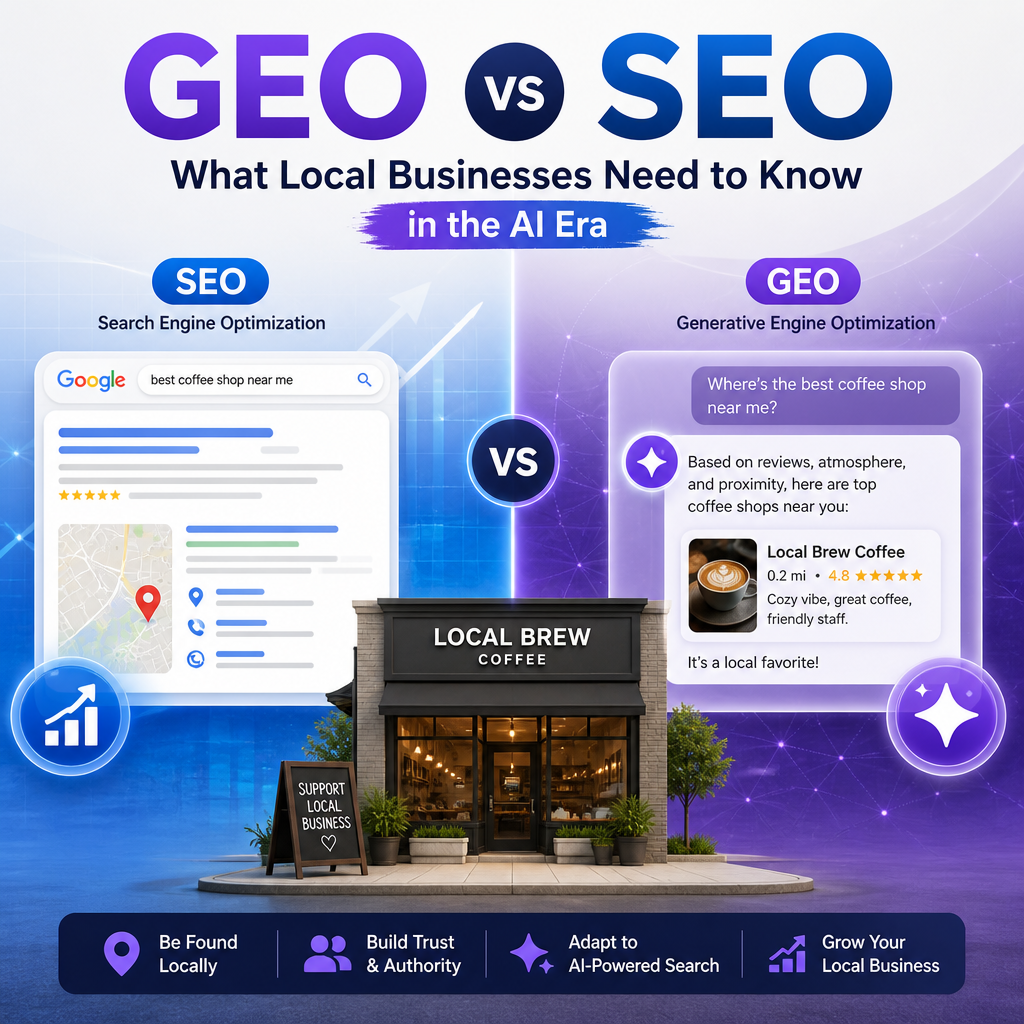
GEO vs SEO: What Local Businesses Need to Know in the AI Era
GEO vs SEO: What Local Businesses Must Know in the AI Era
Search is changing quickly. People no longer rely only on traditional search engines to find local businesses. They also ask AI tools for recommendations, comparisons, directions, and answers to specific questions.
This shift has introduced a new term: Generative Engine Optimization, or GEO. While SEO remains essential, local businesses now need to understand how GEO works and how it differs from traditional search engine optimization.
What Is SEO?
Search engine optimization is the process of improving a website so it appears prominently in traditional search results, such as Google and Bing.
For local businesses, SEO typically focuses on:
- Optimizing service and location pages
- Targeting relevant local keywords
- Building high-quality backlinks
- Improving website speed and mobile usability
- Managing a Google Business Profile
- Earning customer reviews
- Adding accurate business information across directories
The goal is to help search engines understand a business and rank it for relevant queries, such as “plumber in Denver” or “best Italian restaurant near me.”
Local SEO also depends heavily on consistency. A business’s name, address, phone number, hours, and services should be accurate across its website, Google Business Profile, social platforms, and local directories.
What Is GEO?
Generative Engine Optimization is the process of making a business more likely to be discovered, understood, and recommended by AI-powered search tools.
Instead of simply displaying a list of links, generative engines often provide direct answers. They may summarize information from multiple websites and recommend businesses based on factors such as relevance, credibility, location, reviews, and availability.
For example, a customer might ask an AI tool:
“Which family-friendly dentists near Austin accept new patients?”
The response may mention only a few businesses. A company’s GEO strategy helps increase the likelihood that it will be included in that answer.
GEO relies on many familiar SEO principles, but it places greater emphasis on clear information, authority, context, and answer-focused content.
GEO vs SEO: The Main Difference
The key difference between GEO and SEO is how visibility is earned and presented.
SEO is primarily designed to help a website rank in a list of search results. GEO is designed to help a business become a reliable source or recommendation within an AI-generated response.
| SEO | GEO |
|---|---|
| Focuses on rankings and clicks | Focuses on mentions and recommendations |
| Targets search engine results pages | Targets AI-generated answers |
| Often emphasizes keywords and links | Emphasizes context, clarity, and authority |
| Sends users to web pages | May answer questions directly |
| Measures rankings, traffic, and conversions | Measures visibility, citations, mentions, and conversions |
These approaches are not competitors. Strong SEO often supports strong GEO because AI systems still rely on trustworthy online information.
Why GEO Matters for Local Businesses
AI search can influence customers at the moment they are ready to make a decision. Someone may ask for a nearby emergency electrician, a highly rated hair salon, or a reliable accounting firm.
If an AI tool recommends competitors but does not mention your business, you may lose customers before they ever visit a traditional search results page.
GEO is especially important for local businesses because AI tools often evaluate details such as:
- Business location and service area
- Customer ratings and review quality
- Services, products, and specialties
- Opening hours and appointment availability
- Industry expertise
- Mentions on reputable local websites
- Frequently asked customer questions
The more complete and consistent your online presence is, the easier it is for AI systems to understand what your business offers.
How to Prepare Your Business for GEO
1. Keep Business Information Consistent
Review your website, Google Business Profile, directories, and social media accounts. Make sure your contact details, service descriptions, hours, and locations match everywhere.
Inconsistent information can reduce trust and make it harder for search systems to identify the correct details.
2. Create Clear, Helpful Content
Publish content that answers real customer questions. Examples include:
- How much does a roof inspection cost?
- What should I bring to my first therapy appointment?
- How often should a business replace its air filters?
- Do you offer same-day appliance repair?
Use clear headings, concise explanations, and specific details. Content should be written for people first, not stuffed with repetitive keywords.
3. Strengthen Your Local Reputation
Encourage satisfied customers to leave honest reviews. Respond professionally to both positive and negative feedback, and look for legitimate opportunities to earn mentions from local organizations, publications, and industry websites.
Reputation signals help both traditional search engines and AI systems evaluate credibility.
4. Add Structured Data
Schema markup can help search engines interpret information such as your address, phone number, services, reviews, prices, and business hours.
Although structured data does not guarantee an AI recommendation, it provides machine-readable context that supports better understanding.
5. Demonstrate Real Expertise
Show who operates the business, explain your experience, and provide useful insights from your industry. Author pages, case studies, certifications, testimonials, and detailed service pages can all reinforce credibility.
A Combined Strategy Works Best
Businesses should not choose between GEO and SEO. The strongest approach combines both.
Continue optimizing for local rankings, technical performance, and conversions while also creating trustworthy, answer-focused content. Track traditional metrics such as organic traffic and rankings, but pay attention to branded searches, referral traffic, customer inquiries, and mentions in AI-generated results.
The AI era does not make SEO irrelevant. It expands the definition of online visibility. Local businesses that provide accurate information, demonstrate expertise, and answer customer needs clearly will be better positioned in both search results and AI recommendations.
