

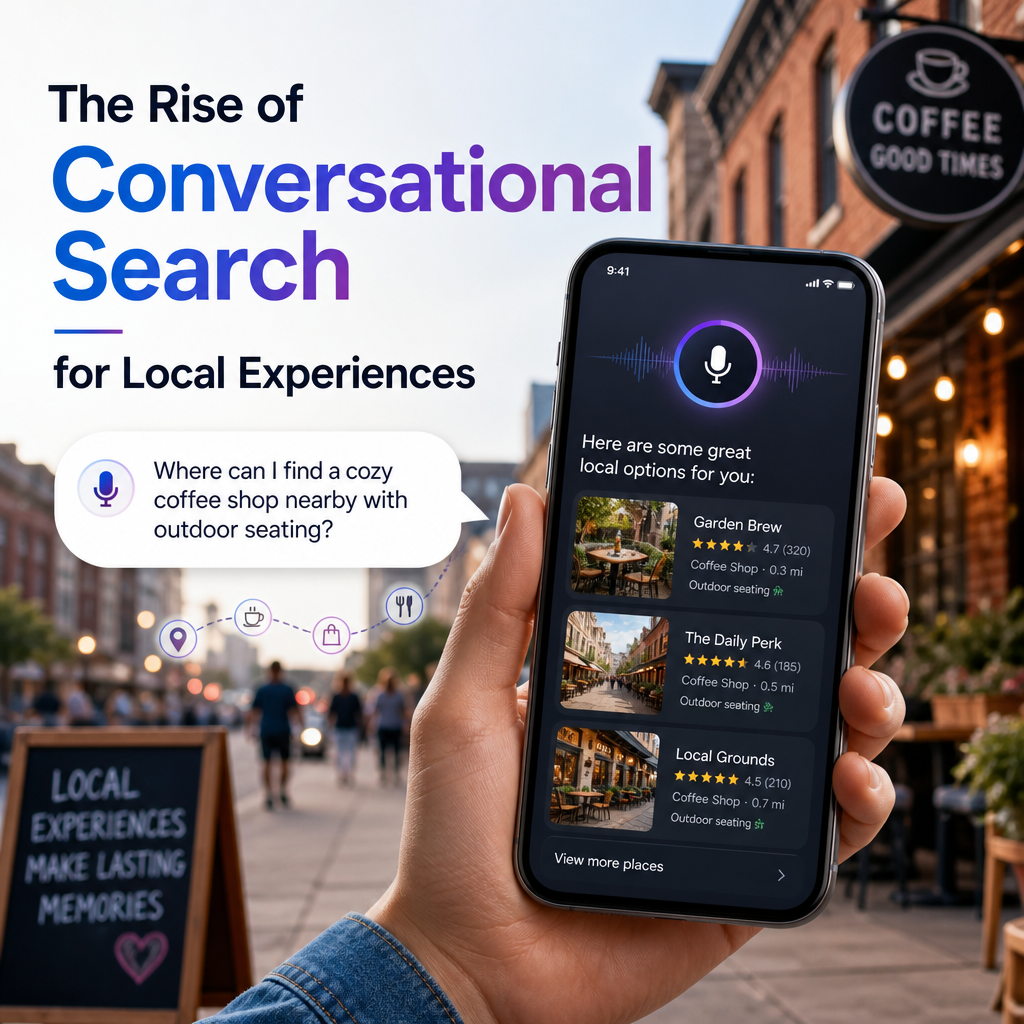
The Rise of Conversational Search for Local Experiences
The Rise of Conversational Search for Local Experiences
Finding a great local experience used to mean scrolling through directories, comparing review sites, or asking friends for recommendations. Today, more people are simply asking a search engine, voice assistant, or artificial intelligence chatbot what to do next.
This shift is driving the rise of conversational search for local experiences. Instead of typing short phrases such as “best coffee shops near me,” users are asking complete, natural questions like, “Where can I find a quiet café with outdoor seating that is open late?” The results are becoming more personalized, practical, and closely connected to real-world decisions.
What Is Conversational Search?
Conversational search allows people to interact with search tools using everyday language. Users can ask follow-up questions, add preferences, and refine their requests without starting over.
For example, a traveler might ask:
- “What are the best family-friendly activities in Chicago?”
- “Which ones are close to the downtown area?”
- “Are any suitable for a rainy afternoon?”
- “Can you recommend one with nearby casual restaurants?”
Rather than treating every search as a separate query, conversational systems use context to understand the user’s broader goal. This makes the process feel more like speaking with a knowledgeable local guide.
Why Local Experiences Are a Natural Fit
Local searches are often personal and highly specific. People are not only looking for businesses; they are looking for experiences that match their timing, interests, budget, and circumstances.
A visitor may want a romantic restaurant, a wheelchair-accessible museum, a dog-friendly hiking trail, or a live music venue that starts after dinner. Traditional search results can provide useful information, but conversational tools make it easier to combine several requirements in one request.
This is especially valuable for:
- Restaurants and cafés
- Museums and cultural attractions
- Tours and outdoor activities
- Entertainment and nightlife
- Family-friendly destinations
- Wellness and fitness experiences
- Seasonal events and local festivals
By interpreting intent more effectively, conversational search helps users move from general discovery to confident action.
How Businesses Are Being Discovered
For local businesses, visibility is no longer based only on ranking for a few traditional keywords. Search platforms increasingly evaluate whether a business appears relevant to a specific question or situation.
A business may be recommended because it:
- Clearly describes its services
- Maintains accurate hours and contact details
- Publishes current pricing or availability
- Receives consistent, detailed reviews
- Answers common customer questions
- Offers useful information about location and accessibility
This means local businesses need to communicate in a direct, natural way. Vague descriptions such as “offering unforgettable experiences” are less helpful than specific details about what visitors can expect.
A tour company, for example, should explain its group size, meeting point, duration, accessibility, cancellation policy, and ideal audience. These details give conversational search systems more useful information to work with.
The Growing Importance of Reviews
Reviews play a central role in conversational local search. A user may ask, “What is the best brunch spot for a quiet atmosphere?” Search systems can analyze review language to identify patterns related to noise levels, service, food quality, or ambiance.
This makes detailed, authentic reviews more valuable than simple star ratings. Businesses should encourage customers to share specific experiences while responding thoughtfully to both positive and negative feedback.
Reviews also help shape expectations. When a business consistently delivers what customers describe online, it is more likely to earn trust and repeat visits.
Preparing for the Future of Local Search
Businesses can prepare for conversational search by focusing on clarity, accuracy, and useful content. Their websites should answer the questions customers are most likely to ask before visiting.
Helpful content might include:
- “What should I bring?”
- “How long does the experience last?”
- “Is parking available?”
- “Is this suitable for children?”
- “What happens in bad weather?”
- “Do I need to make a reservation?”
It is also important to keep business listings updated across maps, directories, and social platforms. Incorrect hours, outdated menus, or missing booking information can quickly eliminate a business from consideration.
A More Human Search Experience
The rise of conversational search for local experiences reflects a broader change in how people discover places. Search is becoming less about matching exact phrases and more about understanding intent, context, and personal preferences.
For consumers, this can make planning faster and more enjoyable. For local businesses, it creates new opportunities to be discovered by the right customers at the right moment.
The businesses most likely to benefit are those that provide clear information, deliver memorable experiences, and understand the questions their customers are already asking.
