

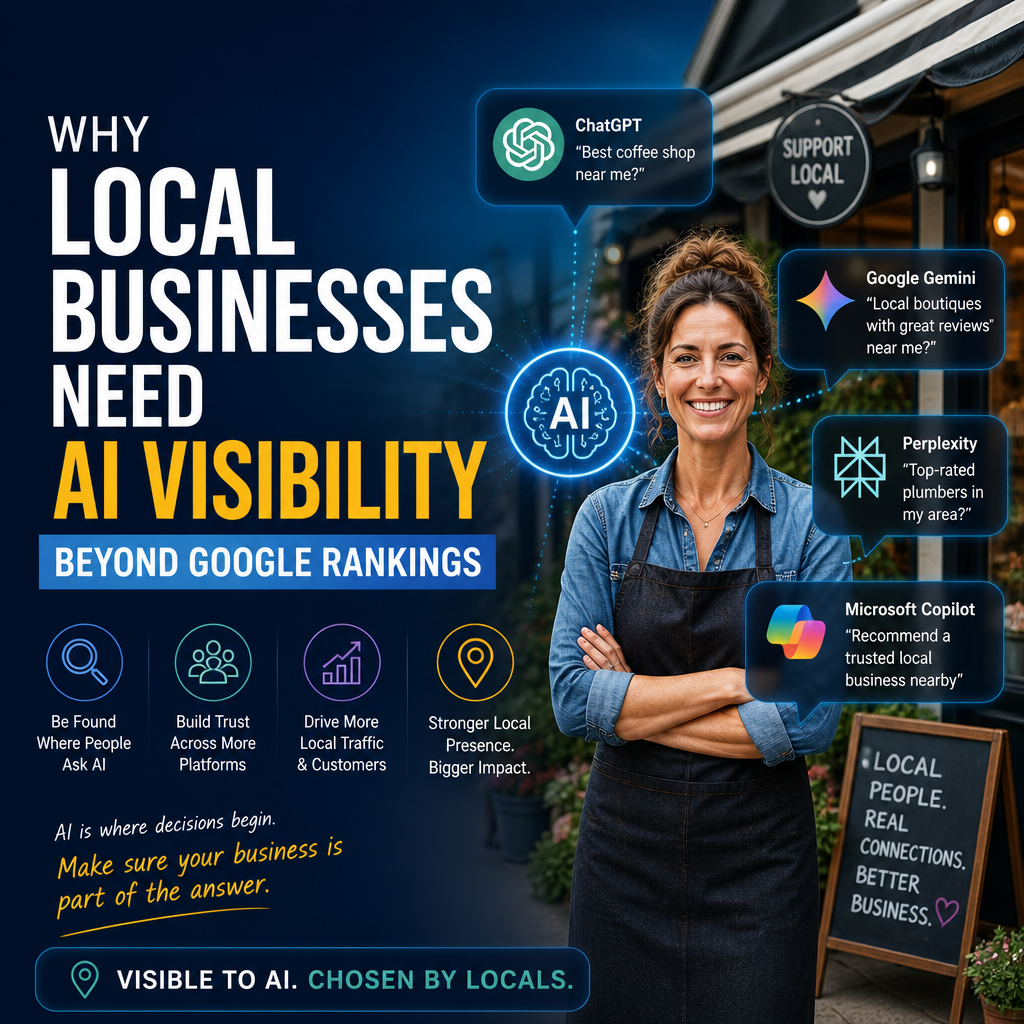
Why Local Businesses Need AI Visibility Beyond Google Rankings
Why Local Businesses Need AI Visibility Beyond Google Rankings
For years, local businesses have focused on one primary digital goal: appearing near the top of Google search results. Search engine optimization, or SEO, remains important, but the way customers discover businesses is changing quickly.
People now use AI assistants, conversational search tools, map applications, social platforms, and voice devices to find recommendations. These systems do more than display links. They interpret questions, compare options, and often provide a direct answer.
That shift makes AI visibility an increasingly important part of local marketing.
What Is AI Visibility?
AI visibility is the likelihood that an artificial intelligence system will recognize, understand, and recommend a business when someone asks a relevant question.
For example, a potential customer might ask:
- “What is the best family dentist near me?”
- “Where can I find an emergency plumber open tonight?”
- “Which local cafés have outdoor seating?”
- “Recommend a highly rated accountant for small businesses.”
In many cases, the user may never visit a traditional search results page. An AI tool may summarize several options and recommend only a few businesses.
Being visible in these answers requires more than ranking for a keyword. AI systems need reliable information about a business, including its services, location, reputation, expertise, availability, and relevance to a specific request.
Google Rankings Are Only One Part of Discovery
Google rankings can generate valuable traffic, but they are not the complete picture of local visibility.
Customers increasingly discover businesses through:
- AI-powered search summaries
- Voice assistants
- Apple Maps and Bing
- Online directories and review platforms
- Social media recommendations
- Industry-specific marketplaces
- Chatbots and recommendation tools
A business may rank well for “roof repair in Denver” but remain absent when a customer asks an AI assistant to recommend a roofer for storm damage. The difference often comes down to how clearly the business is represented across the web.
AI systems gather information from multiple sources. They look for consistent facts, trustworthy reviews, detailed service descriptions, and evidence that a business genuinely serves a particular community.
Why Trust and Context Matter
Traditional SEO often emphasizes rankings, backlinks, and keyword placement. These factors still matter, but AI systems also evaluate context and credibility.
A business is more likely to appear in AI-generated recommendations when its online presence clearly communicates:
- What it does
- Who it serves
- Where it operates
- What makes it different
- Whether customers trust it
- How current its information is
For instance, a general contractor with a basic website may be difficult for an AI system to categorize. A contractor with dedicated pages for kitchen remodeling, bathroom renovations, and storm restoration provides much clearer context.
Detailed content helps AI understand not only what a company offers, but also which customer questions it can answer.
How Local Businesses Can Improve AI Visibility
Keep Business Information Consistent
Business names, addresses, phone numbers, opening hours, and service areas should be accurate everywhere they appear. Inconsistent information can reduce confidence and create confusion for both customers and AI systems.
Review key listings regularly, including:
- Google Business Profile
- Apple Business Connect
- Bing Places
- Yelp
- Industry directories
- Local chamber or association websites
Create Useful, Specific Content
Generic website copy is less helpful than content that addresses real customer needs. Publish service pages, location pages, FAQs, and educational articles that answer specific questions.
Instead of writing “We offer quality plumbing services,” explain what the business does:
- Same-day water heater repair
- Commercial plumbing maintenance
- Drain cleaning for older homes
- Emergency plumbing throughout the surrounding suburbs
Specific details make a business easier to understand and match with relevant searches.
Build a Strong Review Profile
Reviews provide social proof and useful context. Encourage satisfied customers to leave honest feedback and respond professionally to both positive and negative reviews.
Reviews that mention specific services, locations, and customer outcomes can be especially valuable. They help demonstrate what a business is known for rather than simply showing an overall star rating.
Use Structured Data
Structured data, such as LocalBusiness and FAQ schema, gives search engines and AI systems additional information in a standardized format. It can clarify a company’s address, services, hours, pricing, and contact details.
Although structured data does not guarantee visibility, it improves the way digital systems interpret a website.
The Competitive Advantage of Being Cited
AI recommendations often feature a limited number of businesses. That creates a new form of competition: being selected as a trusted answer rather than merely appearing on a results page.
Businesses that invest early in accurate listings, useful content, strong reviews, and clear expertise may gain an advantage as AI-driven discovery becomes more common.
The goal is not to abandon Google SEO. It is to expand the definition of online visibility.
A Broader Local Marketing Strategy
Google rankings remain valuable, but customers now interact with information across an increasingly diverse digital ecosystem. Local businesses need to be discoverable wherever people ask for recommendations.
By improving their online accuracy, publishing genuinely helpful content, earning customer trust, and clearly communicating their expertise, businesses can strengthen both traditional search performance and AI visibility.
The future of local marketing will not be defined only by who ranks first. It will also be shaped by which businesses AI systems understand, trust, and recommend.