

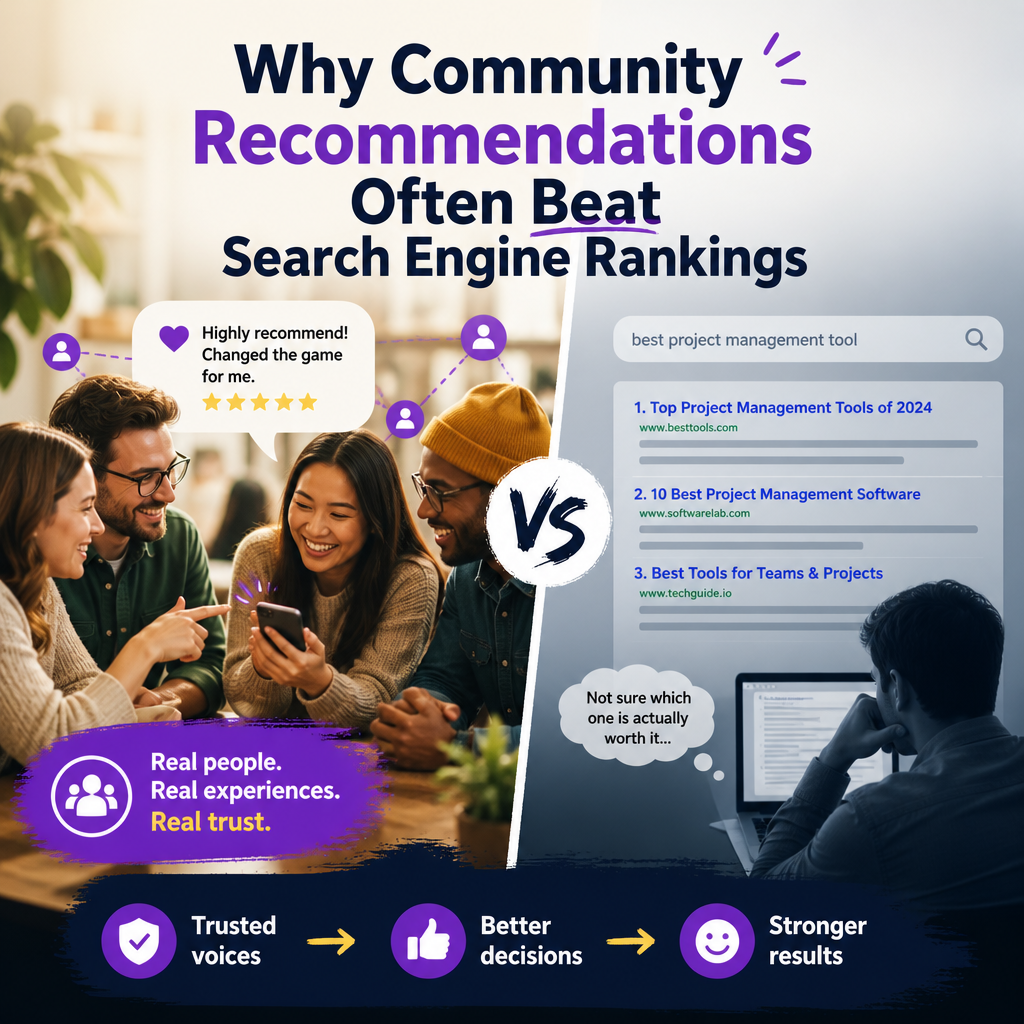
Why Community Recommendations Often Beat Search Engine Rankings
Why Community Recommendations Beat Search Engine Rankings
When people need a restaurant, contractor, doctor, product, or local service, search engines are often the first place they look. Search results can provide thousands of options in seconds, but a high ranking does not always mean a business is trustworthy, reliable, or the right fit.
Community recommendations offer something search engine rankings cannot: personal experience. Advice from people we know—or from active, trusted local communities—often carries more influence than a position on the first page of search results.
Search Rankings Show Visibility, Not Always Quality
Search engines rank pages using complex algorithms. These systems consider factors such as keywords, website structure, backlinks, location, loading speed, and user behavior.
Although these signals are useful, they do not tell the complete story. A highly ranked business may have invested heavily in marketing or search engine optimization without delivering an excellent customer experience.
Search rankings can help people discover options, but they do not automatically answer important questions:
- Is the service dependable?
- Does the business treat customers fairly?
- Is the quality consistent?
- Does the provider understand local needs?
- Would someone use the service again?
Community recommendations often address these questions directly.
Personal Experience Builds Trust
A recommendation from a neighbor, colleague, friend, or community member includes context that a search result usually lacks. People can explain what happened, why they chose a particular business, and whether the final result met their expectations.
For example, a search engine might list several highly ranked plumbers. A local homeowner, however, may recommend one who arrived quickly, explained the problem clearly, and charged a fair price. That personal account is often more useful than a generic description on a website.
Trust grows when recommendations come from people whose judgment we understand. We may know their standards, priorities, and past experiences. Even when the recommendation comes from an online community, repeated positive feedback can create a strong sense of credibility.
Communities Add Local Knowledge
Search engines are designed to serve broad audiences. Communities provide specific, place-based knowledge.
A neighborhood group may know which businesses:
- Serve a particular area reliably
- Understand local regulations
- Offer fair pricing
- Respond quickly to urgent requests
- Have a history with residents
This local context is especially valuable for services that vary by region. A recommendation from someone nearby can reveal practical details that national review sites or ranking pages overlook.
Community knowledge can also help people avoid common problems. Members may warn others about hidden fees, poor communication, unreliable scheduling, or disappointing results. These warnings can save time and money.
Recommendations Reflect Real Relationships
Search results are generally impersonal. They connect users with pages, advertisements, and business listings. Community recommendations connect people with other people.
That human element makes a difference. When someone makes a recommendation, they are often putting their own reputation behind it. This creates accountability. A person is more likely to recommend a business carefully when friends, neighbors, or colleagues may act on their advice.
Businesses benefit from this dynamic, too. A strong recommendation can lead to long-term customer relationships, referrals, and greater loyalty. Unlike a temporary ranking, community trust can continue generating value over time.
Search Engines and Communities Work Best Together
Community recommendations do not make search engines irrelevant. Search is still useful for discovering options, comparing basic information, checking opening hours, and finding contact details.
The strongest approach combines both resources:
- Use search engines to create a shortlist.
- Ask trusted people or local groups for recommendations.
- Read detailed experiences rather than relying only on star ratings.
- Check the business’s website, credentials, and recent information.
- Compare the available evidence before making a decision.
This process balances convenience with judgment. Search engines provide breadth, while communities provide depth and context.
How Businesses Can Earn Community Recommendations
Businesses cannot force genuine recommendations, but they can create the experiences that inspire them. Clear communication, consistent quality, fair pricing, and dependable service are essential.
Companies should also participate responsibly in local communities. Helpful answers, useful information, and respectful engagement can build familiarity before a customer ever makes a purchase.
The goal should not be to manipulate conversations or collect empty praise. It should be to become the kind of business people naturally feel comfortable recommending.
The Lasting Value of Community Trust
Search engine rankings can change overnight. Algorithms are updated, competitors improve their websites, and advertising budgets shift. Community trust is usually more durable because it is based on remembered experiences and relationships.
When people recommend a business, they are sharing more than a name or link. They are sharing confidence. That confidence helps others make decisions with less uncertainty.
In a crowded digital marketplace, visibility matters—but credibility matters more. Search engines may help people find choices, while communities help them choose wisely.
